
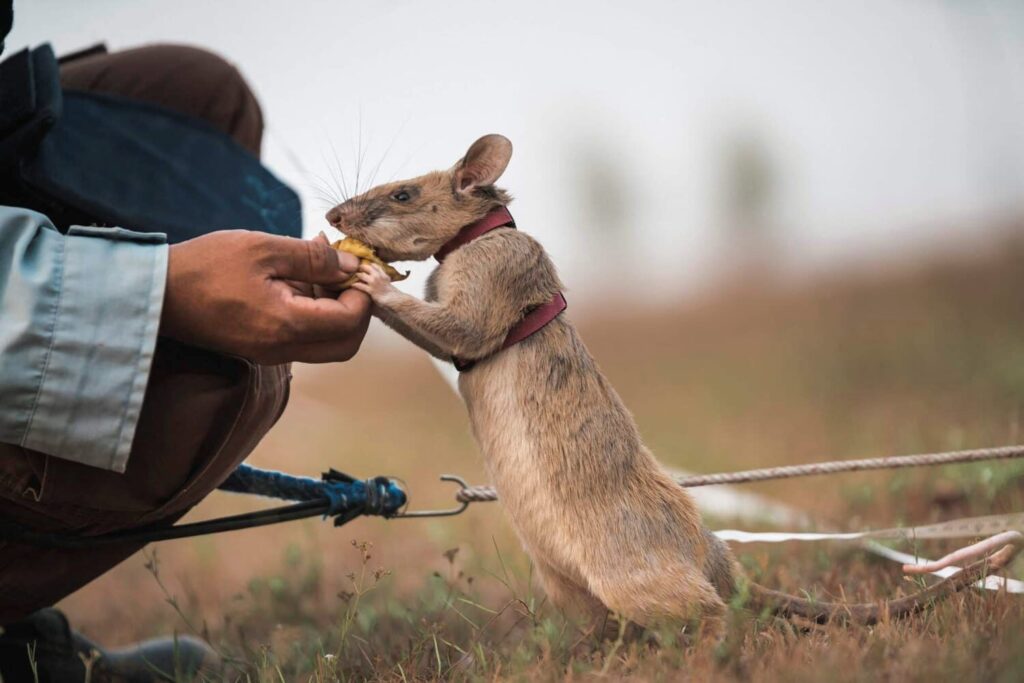
In the light of an early morning in a quiet field in Cambodia tiny paws scurry across the ground. A handler walks behind each creature, holding a thin tether. Suddenly, one of them stops and furiously scratches at the earth. The handler’s face cracks a smile. A soft click! sounds – a signal that the rat has done its job and a reward is coming. A piece of banana is offered, and the African giant pouched rat happily gobbles it up, oblivious to the fact that it has just saved lives. Beneath the soil was a landmine, now marked for safe removal thanks to a creature most people associate with disease. Here, in this sunlit field, rats are the heroes.
The image of a rat-saving humans contrasts centuries of interspecies fear. Yet in countries plagued by unexploded landmines, trained rats have become invaluable partners in humanitarian work. These rodents are part of an innovative program developed by the Belgian organization APOPO in the late 1990s. The idea was born from a simple observation: rats have an extraordinary sense of smell. If dogs could be trained to sniff out drugs or bombs, why not rats? Bart Weetjens, a Belgian researcher who had kept pet rodents as a boy, championed this then-unorthodox idea. What began as a few experiments with lab gerbils quickly evolved into a full-fledged training program using the African giant pouched rat, a species native to sub-Saharan Africa. Over the last two decades, these HeroRATs, as APOPO calls them, have discovered tens of thousands of landmines and unexploded ordnance, helping to make former war zones safe for people again.
What makes these rats so effective at finding landmines? First, their noses are incredibly sensitive – rivaling even dogs in their ability to detect the faint scent of explosives like TNT. In training, the rats learn to associate the smell of explosive chemicals with a food reward. It starts in a sandbox with samples of TNT buried under soil; each time a rat pauses over the correct spot, a trainer clicks a handheld device and offers a treat (banana or peanut mash, two of their favorites). Through repetition and positive reinforcement, the rodents learn that sniffing out that target scent brings delicious rewards. This kind of operant conditioning is similar to how dolphins or dogs are trained, and the rats prove to be quick learners. Within a few months, a young rat can accurately pick out buried explosives in a controlled area.
Another advantage of these rats is their size and weight. Weighing around one to one-and-a-half kilograms, a giant pouched rat is light enough not to trigger a landmine by stepping on it. This is critical: it means they can safely scamper across minefields that would be deadly for a human or even a heavier animal like a dog. Each rat is outfitted with a little harness and guided along a grid by two handlers with a rope, systematically covering the ground. They work diligently, nose to the earth. When a trained rat detects the explosive vapor seeping from a buried mine, it signals the find by scratching at the spot. The handlers can then mark the location for a demining team to safely excavate and neutralize the mine. In this way, a single rat can sweep an area far faster than a person with a metal detector. On average, one rat can search about 200 square meters in 20 minutes, a task that might take a human deminer with a metal detector several days, since the human has to move slowly and investigate every piece of metal scrap. The rats, by ignoring scrap metal and focusing only on the scent of explosives, dramatically speed up the process.
The results have been remarkable. In Mozambique, for example, teams of these rats and their human colleagues cleared over 11 million square meters of land, locating and helping remove more than 13,000 landmines. That work was a contributing factor in Mozambique officially declaring itself landmine-free in 2015 – a milestone that once seemed almost unattainable. Similar success stories have unfolded in Angola, Tanzania, and, more recently, Cambodia. In Cambodia, a single rat named Magawa made international headlines for discovering 39 landmines and 28 other unexploded bombs over his career, a performance so outstanding that he was awarded a gold medal for bravery by a global veterinary charity. The image of Magawa – a rat with a tiny medal hung around his neck – captured imaginations worldwide. Here was a creature typically dismissed as a pest, recognized on the same level as heroic dogs and horses that have served humanity. Magawa’s celebrity helped spotlight the cause, but he was just one of many rats on the front lines. As of today, hundreds of trained rats are busy saving lives, one sniff at a time.
The success of the HeroRAT program is not just about the rats’ innate abilities; it’s also about the unique relationship between these rodents and their human trainers. At APOPO’s training fields in Tanzania and other countries, handlers start working with the rats from a young age. The rodents are born in captivity – often through a breeding program that selects for good health and aptitude – and are handled gently by people so they grow up used to human touch and interaction. By the time a rat is weaned and ready to start training (at just a few weeks old), it already regards the trainer as a source of treats and positive attention. This early socialization is crucial. Unlike the skittish wild rats one might encounter in a city sewer, these rats are comfortable being picked up, carried, and guided on a leash line.
Training a mine-detection rat takes about nine months of daily sessions. The curriculum progresses from simple tasks (finding a piece of TNT in a small box) to complex ones (sweeping a large outdoor field seeded with many buried dummy mines). Patience and consistency are key. The trainers use clickers – the same kind of little device used in pet dog training – to mark the exact moment the rat makes a correct identification, followed immediately by a food reward. Through countless repetitions, the rat learns that “seek the smell, scratch the spot, hear the click, get the banana.” The animals seem to enjoy the game; observers often note that the rats appear eager, even playful, as they run along their search lines. If a rat loses focus or gets distracted (which happens occasionally, especially if a rat is “not a morning person”), trainers might give it a short break or a gentle pep talk. The handlers develop a keen sense of each rat’s personality. Some rats are naturally fast and energetic, covering ground in record time. Others are methodical and slower, or occasionally a bit lazy and need more encouragement. The training managers have learned to adapt to these individual quirks – much as a teacher would adjust for different students – to ensure each animal can perform reliably.
A strong bond of trust forms between the handlers and their rats. After all, the human team is quite literally putting their lives in the rats’ tiny paws. One veteran trainer in Mozambique admitted that on his first live minefield test with the rats, he was terrified – not of the rats, but of the mines. He watched anxiously to see if the animals might miss a device. But when the rats signaled and the deminers dug up actual mines exactly where indicated, his confidence in his furry colleagues soared. Now, he says, if a rat gives an all-clear to a patch of ground, he has no qualms about walking right across it. This level of trust is extraordinary if we consider that culturally, rats have long been symbols of deceit or uncleanliness. Yet here, in a life-and-death situation, humans are relying on the honesty and ability of rats to keep them safe. The rats, for their part, seem oblivious to this pressure. They work for food and affection, unaware that their morning “game” is protecting children from stepping on hidden bombs or farmers from plowing their fields in peace. In a sense, the innocence of the animal – it holds no fear of mines, no bias against any human – makes it the perfect partner for a dangerous job that requires absolute focus on sensory cues.
APOPO’s program also takes great care to ensure the welfare of these little heroes. The rats work only in the early mornings when it’s cool, since the midday heat can be hard on them (especially because, amusingly, they can get sunburned on their furless tails and ears under a tropical sun). Handlers even apply sunscreen to those delicate parts on particularly bright days. Each rat’s work session is brief – about a half-hour of active sniffing with rest breaks – to keep them from getting exhausted or bored. After a successful find, in addition to food, sometimes the trainers give the rat a gentle tickle or stroke, which many of them seem to enjoy (rats, it turns out, can be ticklish and will emit ultrasonic “laughter” when happy, as scientists have noted in other contexts). If a rat consistently struggles with training and isn’t progressing, APOPO does not simply discard it. Instead, that rat might be “retired” early and live out its days as a kind of mascot or companion to the other working rats, rather than being sent into the field. In short, these animals are treated with respect and care – they are teammates, not tools. It’s a truly unique working relationship: humans and rats cooperating for the safety of communities, each dependent on the other. The humans provide guidance, protection, and treats; the rats provide their noses and their diligence. Both contribute intelligence in their own way – one cognitive, one sensory – and the result is a synergy that neither species could achieve alone.
Changing Perceptions
The very notion of a rat as a trusted savior is a sharp inversion of the animal’s traditional image. In popular culture and collective memory, rats have almost always been the villains. They are the shadows in the cellar, the red-eyed swarm under the city streets, carriers of the plague, gnawers of wires, contaminators of grain. No other creature perhaps elicits such automatic revulsion as a rat glimpsed scurrying in a kitchen or sewer. The word “rat” itself is an insult – implying betrayal or filth – and efforts to exterminate them date back centuries. So deeply ingrained is the idea of rats as disease-carrying pests that many people react with fear or disgust at even a pet store rodent in a cage. Yet, the success of the HeroRATs challenges us to re-evaluate this narrative.
Firstly, it’s important to note that the rats being trained for life-saving duties are a specific species with particular traits. The African giant pouched rat is different from the brown rats that infest city subways or the black rats historically blamed (somewhat unfairly) for spreading the Black Death in medieval times. Giant pouched rats are larger, more sociable, and easier to train. They do not typically live in urban garbage dumps; in the wild, they roam African forests and savannas. This makes them less likely to carry the kinds of diseases we associate with city rats. In the controlled environment of APOPO’s facilities, they receive veterinary care, clean food and housing, and regular handling. They are arguably as clean and healthy as any domesticated animal. So when people hear “rats are sniffing out landmines,” one common reaction is shock or skepticism – largely because the only frame of reference they have is the pesky rodents in the attic. But exposure to the HeroRAT program often flips that script. Locals in mine-affected areas, who might initially recoil at the idea of rats, often come to appreciate and even adore these animals once they see them in action. It’s hard not to feel gratitude to a creature that might have just prevented your child from stepping on a bomb in the backyard.
Moreover, the portrayal of rats as unclean plague-bringers is an oversimplification of history. Modern research has suggested that rats may not have been the primary agents of the Black Death’s spread – human fleas and ticks likely played a large role in that terrible pandemic. And while it’s true that wild rodents can carry illnesses (just as many wild animals can), the risk is context-specific. The average person is very unlikely to catch a disease from a rat unless they are living in extremely unsanitary conditions alongside large rodent populations. In fact, in many cities, rats live out their lives in parallel to humans, seldom noticed except when their search for food brings them into our kitchens. They are part of the urban ecosystem, intelligent and resourceful enough to thrive wherever we thrive. It could be argued that their bad reputation comes not just from the diseases they might carry, but from a sort of psychological projection: we see in rats a reflection of our own filth and fears. They skitter in the darkness under our cities, much as we might fear the unseen problems lurking beneath society. For generations, it was convenient to cast them as villains and wage war against them with poisons and traps.
Now, thanks to programs like the landmine-detecting rats, perceptions are slowly shifting. These projects highlight the positive traits of rats: their intelligence, trainability, and even friendliness. Trainers often speak of the rats with affection, noting how some are mischievous, some are shy, and all are motivated not by malice but by the simple pleasures of food and play. In other words, when given a chance, rats exhibit personalities as varied and endearing as those of more traditionally beloved animals. A rat does not set out to scare or offend; it’s largely humans who have cast them in that role. When you see a rat on a harness diligently working a field, ears perked and tail wagging slightly as it sniffs the ground, it’s a revelation. The creature that once symbolized pestilence is now literally uncovering hidden dangers to keep humans safe. It’s doing so not because we forced it through fear – the rats aren’t coerced or punished, they work willingly – but because we found a way to communicate and collaborate across the species barrier.The broader impact of this re-evaluation is significant. It challenges us to question our knee-jerk biases about other animals. If rats, of all beings, can be heroes, what other assumptions about “good” and “bad” animals might be upended? Perhaps no creature is inherently vile; perhaps it’s a matter of context and understanding. By learning to appreciate the rat’s natural talents, we not only solved a practical problem (finding landmines), but we also opened a door in our minds. We granted the rat a new narrative – from villain to valuable ally – and in doing so, expanded our own humanity. It takes humility to admit that an animal we maligned for so long has had something to offer us all this time.