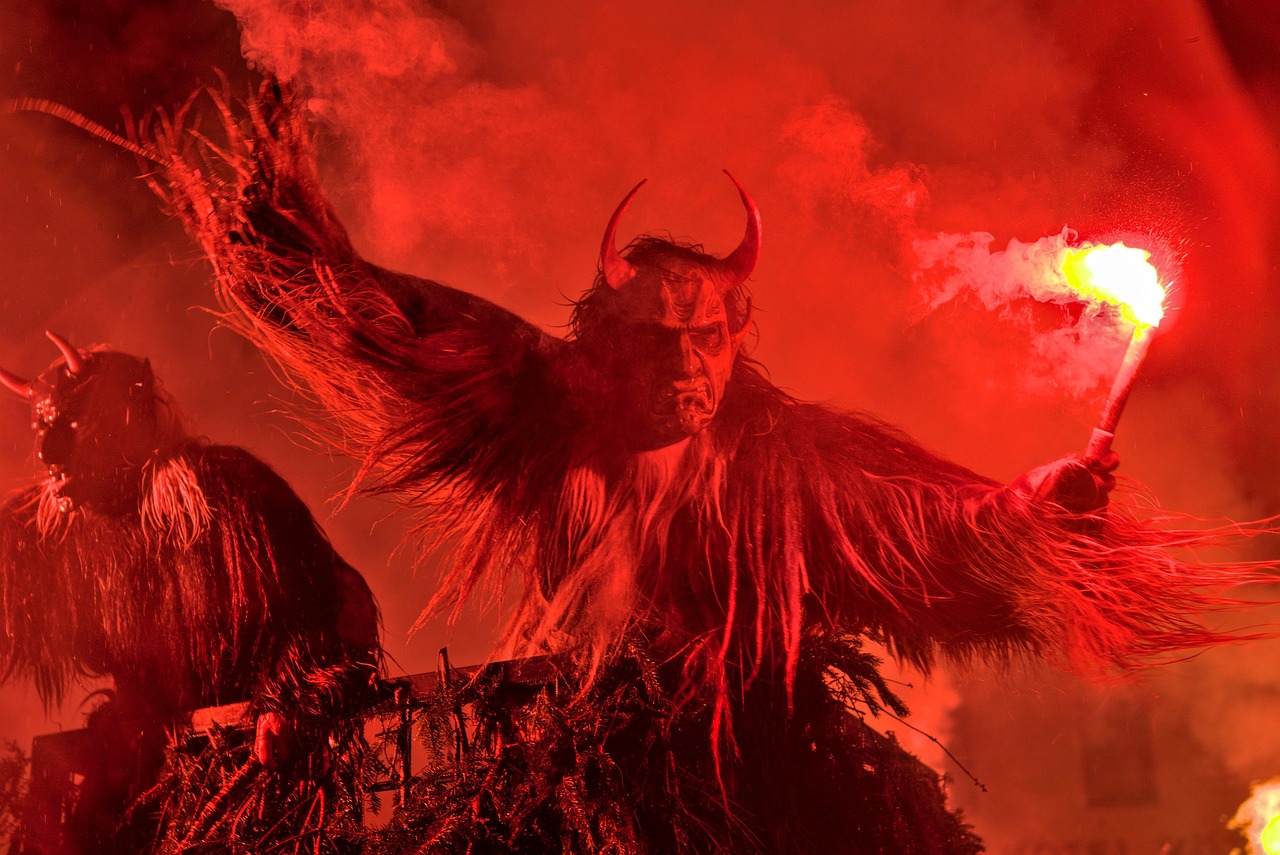
On a crisp December night, under twinkling lights and candy cane stripes, a different kind of Christmas spirit stirs. Instead of sugarplum fairies, we glimpse horned silhouettes and skeletal grins peeking from the edges of our holiday cheer. A new generation has welcomed old ghosts and dark visitors into the season’s festivities. Figures like Krampus, the shaggy, horned “Christmas devil” of Alpine lore, and Jack Skellington, the pumpkin-headed king from The Nightmare Before Christmas, now stand beside Santa Claus in our pantheon of holiday icons. This unlikely rise of darker characters in pop culture hints at something deeper: a cultural embrace of Christmas’s shadows, the mischief and mystery that have always lurked beneath the tinsel and holly.
Mischief and Mayhem of Christmas Past
Modern fascination with dark Christmas figures isn’t as novel as it seems. Historically, the holiday season was never all sweetness and light. In medieval and Tudor England, festivals around Christmastime often featured a “Lord of Misrule,” a clownish leader appointed to oversee revelry and turn social order upside down for a laugh. The Christmas celebrations of old could be raucous and rowdy – a sanctioned period of mischief when commoners might playfully boss around nobles, and excessive feasting, drinking, and comic chaos were the norm. This tradition harkened back to even earlier times: the ancient Roman festival of Saturnalia, celebrated around the winter solstice, was a days-long party of role-reversal, gambling, and wild fun. Echoes of Saturnalia’s spirited disorder carried into European Christmas festivities, where peasants donned costumes, went “mumming” door to door, and demanded food or ale in exchange for goodwill (or else some playful vandalism might ensue).
Not everyone was amused by these antics. By the 17th century, pious voices were denouncing Christmas misbehavior. In England, the Puritans – strict Protestants who sought to purify church practices – were especially scandalized by the drinking, dancing, and masking that accompanied Christmas. To them, the holiday had strayed into ungodly excess. When the Puritans held power under Oliver Cromwell, they outright banned Christmas in England for several years, declaring it a day of penance rather than celebration. Across the Atlantic in colonial New England, their brethren took an even harder stance. In 1659, the Massachusetts Bay Colony enacted a law making it illegal to publicly celebrate Christmas. Shops were ordered to stay open as if it were any ordinary day. If someone was caught feasting, skipping work, or wassailing in holiday merriment, they could be fined five shillings for their offense. For an entire generation, Christmas was literally against the law in Puritan Boston.
What drove such drastic measures? The Puritans believed there was no biblical basis for observing Christmas on December 25. After all, that date had been chosen by early church leaders to co-opt existing pagan solstice festivals, not because Jesus was born in that month. More troubling to them, though, was how people behaved during Yuletide. One clergyman complained that “more mischief is committed at Christmastime than in all the year besides.” The season had become an excuse for “licentious liberty”, a time of bawdy plays, masking in animal costumes, gambling, and even fighting. In their eyes, Christmas had devolved into “Foolstide,” a mockery of sacred observance. Thus, in the New World, they scrubbed it from the calendar entirely, hoping to erase the carnival atmosphere and replace it with sober work and prayer.
Of course, banning Christmas didn’t last. Human nature being what it is, people still longed for cheer in the darkest time of year. After the Puritan grip loosened, old Christmas customs crept back, but they began to change form. By the early 19th century, especially in England and America, the holiday was due for a makeover. Enter the ghosts and goodwill.
Ghosts and Goodwill: Dickens and the Dual Nature of Christmas
It was the Victorian era that truly married the joy and fear of Christmas into one enduring vision, thanks in large part to the imagination of Charles Dickens. In 1843 Dickens published A Christmas Carol, subtitled “A Ghost Story of Christmas.” At that time, Christmas wasn’t yet the major, family-centric holiday we know today – it was a fading festival in need of reinvention. Dickens seized on the old tradition of telling ghost stories on Christmas Eve and wove it into a moral tale that brimmed with both supernatural terror and heartfelt redemption.
In Dickens’s story, cold-hearted Ebenezer Scrooge is confronted by spectral visitors: the ghost of his dead partner Marley, and the Spirits of Christmas Past, Present, and Yet-to-Come. These apparitions certainly frightened Scrooge (and readers) with their chilling warnings and visions of loneliness and death. Victorians gathered by the fire to read this Christmas ghost story, shivering at the suspense. But crucially, the fear served a purpose: by surviving the night’s haunting, Scrooge awakens on Christmas Day a changed man, giddy with joy and compassion. The novella captured a profound truth about the holiday: that light means more after darkness, and joy is sweeter after facing one’s fears. Dickens himself called it “this Ghostly little book” and hoped its ghost would “haunt [readers’] houses pleasantly.” The public response proved his instinct right. A Christmas Carol was an instant success and has never been out of print since. Its impact on Christmas culture was immense.
Dickens helped solidify many elements we now think of as timeless: festive generosity toward the poor, family gatherings, hearty feasts (complete with the prize turkey he has Scrooge send to the Cratchits), and the very phrase “Merry Christmas” entering popular usage. Yet he also ensured that a trace of the eerie remained part of Christmas. After Dickens, the Christmas ghost story became a beloved Victorian tradition, with magazines printing spooky winter tales each year. People delighted in a shiver of fear as part of their seasonal merrymaking. In effect, Dickens restored some of the old balance of the holiday, bringing back the interplay of shadows and light, of solemn reflection and jollity, but he did so in a more civilized and emotionally resonant way. The misrule of the past was transformed into parables of personal transformation. Instead of rowdy pranks, there were gentle chills and moral lessons. Still, the dual nature remained: Christmas was both cozy and haunted, a time to gather in warmth against the cold and also to acknowledge ghosts of memory, regret, and hope.
The Dark Companions Return: Krampus, Jack Skellington, and Modern Pop Culture
Today, our culture is once again embracing the darker aspects of Christmas, but with a twist of playfulness and irony. After decades of being portrayed mostly as a sentimental, commercialized season of pure joy, Christmas’s old shadow figures have come knocking at the door – and we’ve let them in with glee. Perhaps the best example is Krampus. This horned, furry creature from Central European folklore has lately leapt from obscurity into the global imagination. Traditionally, Krampus was the sinister counterpart to kindly Saint Nicholas, visiting children on Krampusnacht (the eve of St. Nicholas Day in early December). While St. Nick brought gifts to good children, Krampus swatted naughty ones with birch switches or even carried them off in his sack. For centuries, Alpine villages kept this legend alive with men dressing as terrifying demons to roam the streets, rattling chains and clanging bells to scare kids straight. It was a weird, wild custom – but largely unknown in America until recently.
In the past decade or two, Krampus has staged a remarkable comeback, especially in the West. Starting in the early 2010s, cities like Los Angeles, Philadelphia, and New Orleans began holding Krampus parades and “Krampuslauf” runs in December, where people don elaborate Krampus costumes and celebrate the macabre side of the holidays. By now, dozens of such events occur annually across the United States and Europe, complete with Krampus greeting cards, sweaters, and figurines. Hollywood also took notice. A wave of horror-comedy films such as Krampus (2015) introduced wider audiences to the legend with ghastly flair – that 2015 movie even topped the box office for its opening day, proving that a demonic anti-Santa could captivate mainstream viewers. Many other low-budget Krampus films followed, and the character began popping up in books, TV shows, and even family-friendly cartoons (often in toned-down form). The once-local devil of Christmas had become a pop culture celebrity.
What explains this surge of interest in a figure as dark as Krampus? On one level, it’s simply fun. There’s a delicious thrill in spicing sugary holiday cheer with a dash of horror. Just as children at Halloween enjoy being safely scared by ghosts and monsters, adults at Christmastime can enjoy the catharsis of a good scare or laugh at a dark joke. Krampus, with his lolling tongue and rattling chains, provides a counterpoint to Santa’s wholesome image – he is the yin to Santa’s yang, the chaos to his order. By inviting Krampus back into our celebrations, people may be expressing a bit of rebellion against the overly commercial, saccharine side of Christmas. It’s as if we collectively decided that all the forced merriment needed a counterbalance, a little taste of darkness to make the light shine brighter.
The same could be said of other modern holiday figures like Jack Skellington. Tim Burton’s The Nightmare Before Christmas (1993) has become a classic precisely because it straddles two worlds: the spooky Halloween ethos and the warm Christmas spirit. In the film, Jack Skellington, the bored “Pumpkin King” of Halloween Town, discovers Christmas and is enchanted by its joy. Yet when he attempts to take over the role of “Sandy Claws,” he brings along ghoulish gifts and creepy twists. Through Jack’s misadventure, the story cleverly explores the contrast between Halloween frights and Christmas cheer, ultimately finding a harmony between them. Many viewers, especially those who grew up with a love of both holidays, resonated with this blend of dark and light. The image of Jack – a skeletal figure in a Santa suit, gliding in a coffin sleigh – is iconic now. It symbolically asks: why can’t Christmas contain a bit of Halloween’s magic?
Beyond specific characters, there’s a broader cultural psychology at play. We live in complicated times where the year’s end can stir up stress, nostalgia, and even sadness amid the festivities. Embracing the “darker aspects” of Christmas in pop culture might be a way of validating those less cheerful emotions. Not everyone feels nonstop joy in December – and folklore like the Krampus legend acknowledges that, wrapping our anxieties and disappointments in a fantastical form. A scary-but-fun story or a morbid joke can provide relief, a way to vent pressure and bond over the shared experience of not being perfectly merry. Even the old tradition of the Christmas ghost story, now being revived by some enthusiasts, recognizes that the long winter nights invite contemplation of mortality and the unknown. These stories and figures externalize our inner “demons” – greed, regret, selfishness, fear – and then often vanquish or playfully subvert them, allowing us to enter the new year feeling a little lighter.
Finally, the resurgence of Christmas mischief and darkness may simply be part of the cyclical nature of culture. What was old becomes new again. In the Victorian period, people longed for a return of heartfelt Christmas traditions and found it in nostalgic works like Dickens’s. In our era, perhaps we long for a return of some edge and authenticity amid an overly sanitized, materialistic holiday. So we bring back the monsters and tricksters. It’s telling that even as Krampus gains popularity, Santa himself has been portrayed in a tougher light in recent pop culture – from tongue-in-cheek horror retellings to action-comedy films where Santa has a gritty side. These imaginative twists show an appetite for complexity in our mythologies.
Christmas has always been a dance of darkness and light. The world outside is cold and dark, yet inside our homes we kindle warmth and hope. We hang shining stars on evergreen trees, a reminder that light will return. But we also tell tales of ghosts and strange visitors, reminders that the darkness has its place too. The rise of characters like Krampus and Jack Skellington in popular culture is, in a sense, a return to form, a reconnection with the full palette of human emotions that the holiday can evoke. By embracing the shadows of Christmas, we don’t diminish the joy; we deepen it. In the flicker of the hearth and the howl of a winter wind, we find beauty in contrast. As Dickens showed us and our ancestors knew, a Christmas that can acknowledge fear and wickedness can also fully celebrate kindness and joy. The dark makes the light of the season glow that much brighter.