To understand room-temperature superconductors, we first need to grasp what a superconductor is. A superconductor is a material that conducts electricity with zero resistance – meaning, an electric current can flow through it without any energy lost as heat. This phenomenon, discovered in 1911 by Heike Kamerlingh Onnes, is extraordinary because in ordinary conductors (like copper wires) some energy is always dissipated. However, all superconductors known for most of the past century only exhibited this zero-resistance behavior at extremely low temperatures (often close to absolute zero). Over time, scientists found “high-temperature” superconductors that work at less extreme temperatures, but even those require cooling with liquid nitrogen or other cryogens (on the order of -200 °C).
A “room-temperature superconductor” is the hypothetical (and highly sought-after) material that would act as a superconductor at everyday ambient temperatures – roughly around 20–25 °C (68–77 °F), without the need for any cooling. In more technical terms, it would have a critical temperature (T_c) above 273 K (0 °C) so that it could be used in normal conditions. Achieving superconductivity at room temperature has been called the “holy grail” of condensed matter physics because it would revolutionize numerous technologies (as we will discuss in the next section).
It’s important to note that temperature is only part of the challenge. Many of the highest-temperature superconductors we’ve discovered also require extremely high pressures to function. For example, as of 2023 the material with the highest confirmed superconducting transition temperature is lanthanum decahydride (LaH₁₀), which superconducts around 250 K (-23 °C) but only under a pressure of about 150 GPa (which is 1.5 million times atmospheric pressure, achievable only in lab devices like diamond anvil cells). In contrast, the highest T_c at ambient pressure is much lower – the record is about 138 K (-135 °C) in a cuprate superconductor (a type of ceramic). So, when we talk about “room-temperature superconductors,” we ideally mean at atmospheric pressure as well, otherwise the material wouldn’t be practical outside of a lab. The ultimate goal is a material that is superconducting at ~300 K and normal pressure.
How can a material have zero resistance? In simple terms, in a superconductor the electrons form paired states (called Cooper pairs) that can move through the lattice of the material without being scattered. In a normal conductor, electrons collide with atoms and lose energy (causing heating). But in a superconducting state, below T_c, a kind of phase transition occurs: electrons move in a coordinated, frictionless way. Often this is mediated by lattice vibrations (phonons) in conventional superconductors – the electrons essentially “ride together” in a way that avoids the usual bumps of the lattice. Newer high-T_c superconductors involve more complex mechanisms that are still being researched. The key point is that once a material is in the superconducting state, it can sustain a current with no electrical resistance and can also expel magnetic fields (the Meissner effect).
How Room-Temperature Superconductors Could Change Technology
Room-temperature (and ambient-pressure) superconductors would be nothing short of game-changing for our technological infrastructure. Virtually every sector that uses electricity or magnetic fields could be transformed. As one science writer succinctly put it, “Room-temperature superconductors would revolutionize nearly every technology on Earth.” This is not hyperbole – here are some of the major impacts such a breakthrough would have:
Power Transmission and Energy Efficiency: Today, about 5–10% of electric energy is lost as heat in the wires during transmission from power plants to homes and businesses. A superconducting wire carrying current with zero resistance would eliminate these transmission losses. In the U.S. alone, roughly 10% of generated electricity is lost in the grid. With superconductors, we could save that energy – which is like suddenly making every power plant 10% more efficient, or significantly reducing greenhouse gas emissions for the same power delivered. Moreover, superconducting power lines could carry much higher currents without heating, potentially allowing a single cable to transmit the power of many conventional lines. This would enable long-distance, high-capacity power transmission – for instance, moving solar energy from one side of a continent to the other with minimal loss. The electrification of our world could accelerate, as one professor noted: room-temperature superconductors would let us do more with the same amount of generation, using less natural resources and producing less waste. We could even envisage a global supergrid connecting different time zones’ renewable energy, because distance would no longer incur large losses.
Motors:
Superconductors can carry immense currents and produce very strong magnetic fields, which can make electric motors and generators far more powerful for their size. If motors could be built with superconducting windings (and operated at room temp without complex cooling), we could have lighter and more efficient engines for everything from industrial machinery to electric vehicles. For example, superconducting motors and generators could improve the efficiency of wind turbines or ship propulsion. They could also enable new designs of maglev trains with cheaper, more reliable superconducting magnets (currently, maglevs use superconductors cooled by liquid helium or nitrogen – a room-temp version would simplify the system greatly).
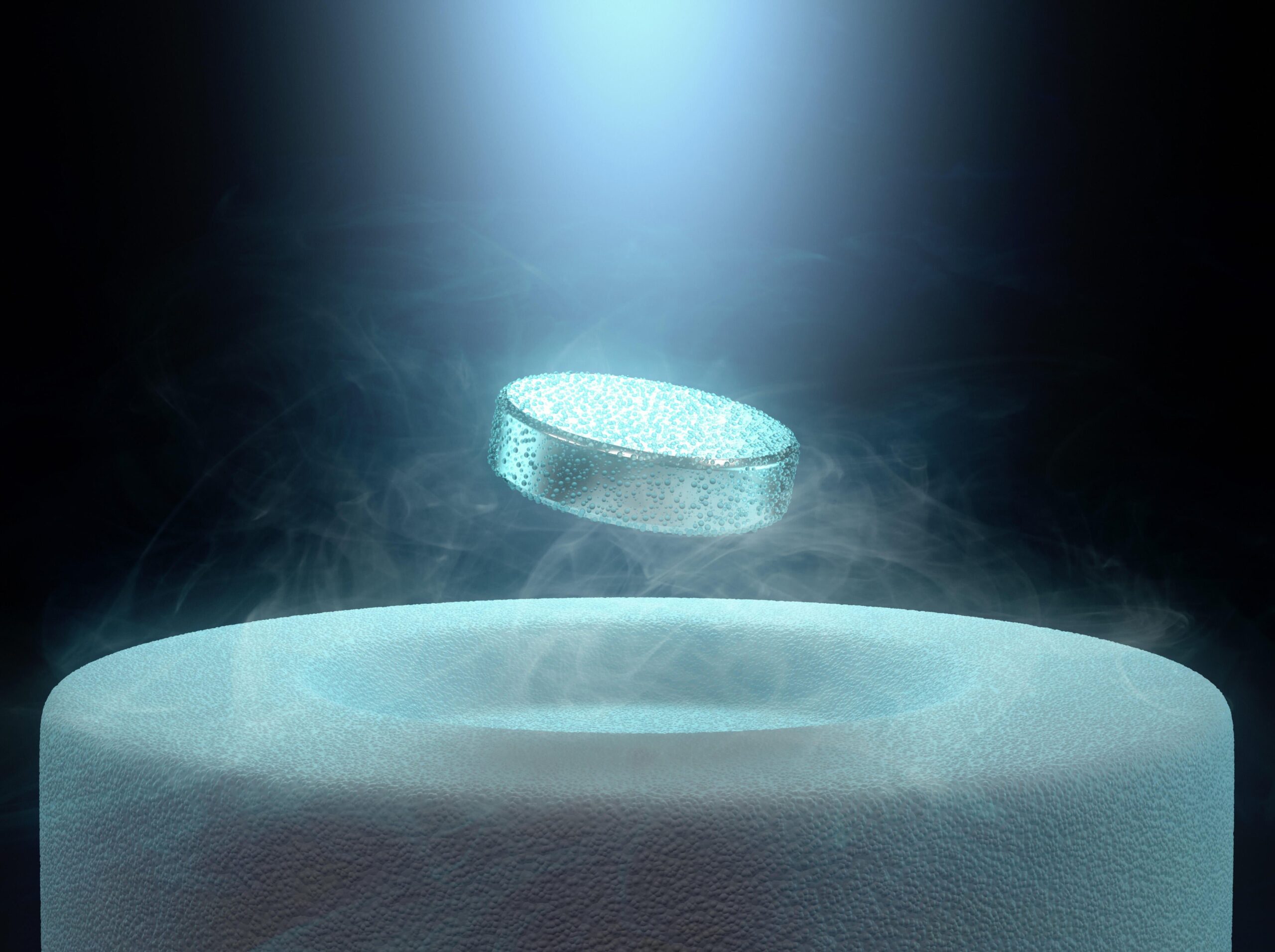
Magnetic Levitation and Transportation: Speaking of maglev, superconductors are famous for enabling magnetic levitation. A common demonstration is a magnet hovering above a superconductor that’s been cooled with liquid nitrogen, illustrating the expulsion of magnetic field (Meissner effect) as seen in levitating magnet demos. With room-temperature superconductors, permanent magnetic levitation could be achieved without any refrigeration. This could lead to frictionless bearings, maglev trains that are much more economical, and perhaps new forms of flywheel energy storage (where a superconducting bearing lets a rotor spin with almost no friction).
Quantum Computing and Electronics:
Many quantum computers (like those built by IBM, Google, etc.) rely on superconducting circuits operating at extremely low temperatures. If superconductors worked at room temperature, quantum computers could potentially operate without expensive dilution refrigerators, vastly simplifying their design and reducing power consumption. Even classical electronics could benefit: superconducting wires and interconnects would have no resistive heating, meaning computers could run cooler and more efficiently. We might also see superconducting logic circuits for ultrafast computing – there have been experimental superconducting digital circuits (RSFQ logic) that can switch much faster than semiconductor transistors, but they haven’t left the lab due to cooling requirements. Room-temp superconductors could revive these concepts, possibly leading to a new generation of extremely energy-efficient, high-performance computers.
Medical Technology (MRI and beyond): MRI machines and other devices like NMR spectrometers use superconducting magnets to generate strong magnetic fields, but they currently require liquid helium cooling. A room-temperature superconductor magnet would make MRI machines much simpler to maintain (no cryogen refills, lower energy usage) and possibly cheaper, meaning more hospitals and clinics could afford them. It would also eliminate the risk of quenching (a sudden loss of superconductivity that causes the helium to boil off). Beyond MRI, any technology using strong magnets – from particle accelerators to fusion reactors (tokamaks) – would benefit. Fusion reactors, for instance, rely on superconducting coils to confine plasma; if those could run at room temperature, reactor designs could be more compact or efficient.
Energy Storage: Superconductors enable devices like SMES (Superconducting Magnetic Energy Storage), where you store energy in the magnetic field of a coil with zero resistance. Today, SMES is only used in niche applications because you need to keep the coil cold. At room temp, SMES could become a viable way to store large amounts of energy with very quick response times (useful for grid stability or backup power) without energy loss over time.
In short, a room-temperature superconductor would touch almost every aspect of technology that involves electricity or magnetism. It’s often said that it could usher in a second electrical age – much like how the original discovery of superconductivity enabled technologies like MRI, the widespread availability of a ambient superconductors could enable devices and systems we haven’t even conceived of yet, because engineers have largely treated superconductivity as off-limits outside of very specialized applications due to cooling constraints. As an example of scale: Paul Chu, a pioneer in high-T_c superconductors, pointed out that if we had such materials, we could transmit electricity thousands of miles with no loss, fundamentally changing energy logistics and usage. The ability to make lossless power lines, ultra-efficient grids, powerful compact motors, and magnetically levitated transport could dramatically improve energy efficiency and reduce costs across the board.
How Close Are We to Achieving Them?
Despite the enormous appeal, room-temperature superconductors have remained elusive. However, there has been significant progress in the last few decades, with the bar for critical temperature steadily rising. Scientists have been aggressively searching for materials (often using high pressure or novel chemical compositions) that superconduct at ever higher temperatures. So, how close are we really? The honest answer is: we’re closer than we used to be, but not there yet. There have been some tantalizing claims, especially recently, but they have faced intense scrutiny and skepticism from the scientific community.
The most reliable results so far involve hydrogen-rich compounds under extreme pressure. Metallic hydrogen was long theorized to be a room-temperature superconductor. In practice, instead of pure hydrogen, chemists have combined hydrogen with other elements to create superhydrides. In 2018–2020, experiments with lanthanum hydride (LaH₁₀) achieved superconductivity around 250 K (−23 °C) at megabar pressures. Later, in 2020, a carbonaceous sulfur hydride reportedly hit ~287 K (14 °C) at 267 GPa (another record), though that result’s reproducibility has been questioned. These are essentially near-room-temperature superconductors, but under crushing pressures. They show it’s at least physically possible to reach room temperature, but the challenge is to do it at ambient pressure so the material is usable in everyday settings.
In 2023, a high-profile claim was made by a team from the University of Rochester: they reported a nitrogen-doped lutetium hydride that supposedly superconducts at 294 K (21 °C) under a much lower pressure of about 1 GPa (which is still 10,000 atmospheres, but far less than previous hydride experiments). If true, that would have been a historic breakthrough – essentially room temperature at a pressure that, while high, might be engineering-manageable. However, this claim (published in Nature) was met with widespread skepticism about the data and methods. The lead author had earlier controversial claims and was even accused of scientific misconduct in unrelated work. Sure enough, within months, other scientists attempting to replicate the result did not observe superconductivity in the material. Eventually, Nature retracted the paper (late 2023) after concerns about data fabrication. So that particular material, sometimes nicknamed “red matter,” is not confirmed – it remains an open question, but confidence is low.
Around the same time (mid-2023), an even more sensational claim went viral on the internet: a group from Korea claimed discovery of a room-temperature, ambient-pressure superconductor called LK-99 (a lead–apatite compound with copper substitutions). They reported signs of superconductivity up to 400 K (127 °C) – well above room temp – without needing any pressure. This news spread like wildfire online and in media, because if true it would truly change everything overnight. However, within a few weeks, multiple laboratories worldwide synthesized LK-99 and tested it, finding no evidence of zero resistance or strong diamagnetism (the hallmark of superconductivity) in those samples. It turned out the material was not a superconductor; the initial results were likely measurement artifacts or minor impurities causing confusing signals. In short, the LK-99 saga was a false alarm. It served as a cautionary tale about wishful thinking – even scientists can be swept up in superconducting excitement – but also demonstrated the worldwide eagerness to attain this goal.
So, despite those 2023 drama-filled episodes, the fact remains that no superconductors are yet confirmed to work at room temperature under normal pressure. The record (accepted by the community) still stands around -23 °C (250 K) at very high pressure. That being said, the trend is upward, and researchers are far from giving up. In January 2024, for example, a team reported a new milestone of sorts: they achieved what they call “ambient superconductivity” in a graphite-based material, though details are still being debated. And beyond experimental breakthroughs, there is progress in understanding the science that might lead to new strategies. Scientists at Caltech recently discovered a new state of matter related to superconductivity – a modulating Cooper pair density wave – which, while not a superconductor itself, deepens understanding of the mechanisms that might be exploited to raise T_c. Each incremental insight (like understanding how certain nickelate materials superconduct, or how pressure causes hydrogen sulfide to superconduct) feeds into the larger quest. There are also big efforts using computational materials science and AI to predict new superconductors; hundreds of candidate compounds are being theorized and some synthesized.
How close are we in time? It’s hard to predict – some researchers remain optimistic it could be just years away if a lucky combination is found, while others caution it could still be decades. The complexity of high-temperature superconductivity (especially in complex, often brittle materials) means we might also need a new theoretical breakthrough to guide us. Nonetheless, the steady increase in critical temperature over the years (from 30 K in mid-20th century, to 77 K in 1986, to 138 K in the 1990s, to 250 K in 2018) gives hope that 300 K is not an unreachable target. Achieving it at ambient pressure is another huge leap – currently the hydride superconductors that work near room temp require extreme pressure to force hydrogen atoms close enough – but researchers are looking at ways to stabilize such structures at lower pressures, or find entirely different classes of materials.
One encouraging angle is the possibility of room-temperature superconductors in metastable phases. Scientists like those at University of Houston (including Paul Chu) have experimented with techniques like “pressure quenching”, where they apply high pressure to a material to induce a high-T_c phase and then lock in that phase by reducing temperature and releasing pressure. This aims to create a material that superconducts at higher temperature without continuous high pressure. There have been reports of modest success in retaining enhanced superconductivity at ambient pressure using this method, though not to room temperature yet.