
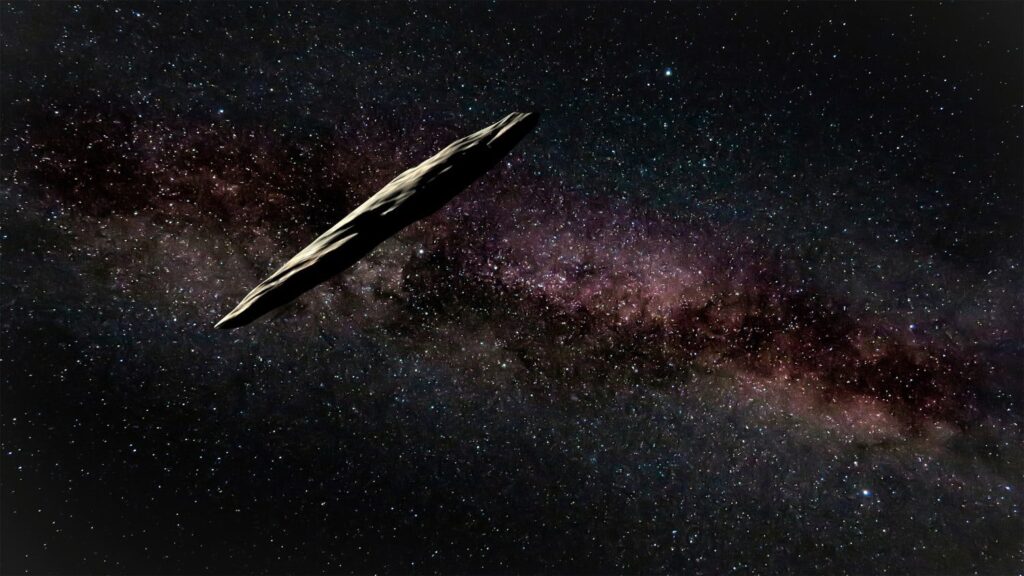
In late 2017, astronomers in Hawaii spotted an object hurtling through our solar system that defied all expectations. It was small, elongated, and moving so fast that the Sun’s gravity could not hold onto it. This visitor was quickly recognized as the first interstellar object ever observed up close – meaning it came from another star system entirely. They named it ‘Oumuamua, a Hawaiian word meaning “scout” or “messenger,” as if it were an emissary from afar. From the moment of its discovery, ‘Oumuamua captivated scientists and the public alike with its mystery. Here was a piece of another star’s history passing briefly through our cosmic neighborhood, and we had only weeks to observe it before it faded from view.
At first, ‘Oumuamua was assumed to be a comet – a ball of ice and dust – since comets commonly roam the outskirts of solar systems. Yet as it passed near the Sun, it showed no fuzzy halo of vaporizing ice, no tail streaming out. It looked like a barren rock. So astronomers reclassified it as an asteroid. But it didn’t behave quite like a normal asteroid either. As it cruised away, telescopes noticed a slight but odd acceleration in its motion, as if something unseen were gently pushing it. On top of that, the pattern of sunlight reflecting off ‘Oumuamua suggested an extremely elongated shape. Some estimates said it could be up to a few hundred meters long but only a tenth as wide – shaped either like a cosmic cigar or perhaps a flat pancake. Such proportions were unlike any asteroid or comet seen before. This combination of weird traits – no comet tail, anomalous acceleration, and peculiar shape – left scientists scratching their heads. What exactly was this thing?
The data were frustratingly limited: ‘Oumuamua was already on its way out of the solar system at about 87 kilometers per second, and it was too faint to see in detail. With so many unanswered questions, a tantalizing idea emerged in discussions and media reports: could it be an alien spacecraft? Normally, scientists are very cautious about invoking extraterrestrial explanations. But ‘Oumuamua’s behavior was so puzzling that a few reputable astronomers openly speculated about non-natural origins. Suddenly, what began as a routine discovery of a space rock took on an almost science fiction quality.
Science Fiction or Scientific Debate
The notion of an interstellar visitor being an alien craft wasn’t entirely new – it felt like a scene from a novel come to life. In fact, decades before, famed author Arthur C. Clarke wrote Rendezvous with Rama, a story about a cylindrical starship from another civilization drifting into our solar system. The parallels were hard to ignore: Clarke’s fictional ship “Rama” and ‘Oumuamua were both long and cigar-shaped objects from the depths of space. Early on, before the Hawaiian name was chosen, some astronomers half-jokingly nicknamed the object “Rama” because of that resemblance. The idea that perhaps this was not a rock at all, but an artifact created by intelligent life, captured people’s imaginations.
In 2018, a Harvard astronomy professor, Avi Loeb, and a colleague published an academic paper arguing that we should consider the possibility that ‘Oumuamua was an artificial object – perhaps a probe sent by an alien civilization. They pointed out that the unexplained acceleration could, in theory, be produced if the object were extremely thin, like a solar sail catching the sunlight. Nature, they noted, doesn’t usually make objects as thin as a sheet, so why not consider an artificial origin? This provocative hypothesis made headlines around the world. For many, it was thrilling to hear a respected scientist discuss aliens so openly. For others – especially many astronomers – the claim was premature and sensational.
A lively debate ensued. On one side were Loeb and a few others who insisted that we follow the evidence even if it points to something extraordinary. On the other side were the majority of experts saying that while ‘Oumuamua was indeed strange, it still fell within the realm of natural phenomena. Comets and asteroids can be odd; just because we haven’t seen one exactly like this before doesn’t mean it’s alien technology. Critics argued that the alien hypothesis should be a last resort – invoked only if every natural explanation fails. And several natural explanations were still on the table: maybe ‘Oumuamua was a fragment of a shattered planet, or an unusual comet with hidden ice that didn’t produce a normal tail, or something like a frozen iceberg of hydrogen that could cause a push without visible gas. In 2019 and 2020, researchers proposed a variety of such ideas. Each had its complications, but together they showed it was plausible to imagine ‘Oumuamua as a bizarre but natural object.
Meanwhile, efforts were made to gather any possible evidence. A radio telescope array was turned toward ‘Oumuamua to eavesdrop for any artificial signals, in case it was transmitting. No signals were heard. The object’s trajectory was mapped meticulously; it didn’t show any course changes or maneuvers that one might expect from a powered spacecraft – it was gliding along a path shaped by gravity and whatever outgassing or pressure caused the extra push. By mid-2018, as ‘Oumuamua disappeared into the darkness, most scientists leaned toward the view that it was likely a natural interstellar wanderer. But frustratingly, because it was discovered on its way out, we would never get a close-up look or a definitive answer. The mystery remains: a minority still wonder if we missed our first brush with alien technology, while the consensus is that nature probably cooked up something surprising yet mundane.
Our Second Visitor and Continuing Mystery
If ‘Oumuamua opened the door to the idea of interstellar visitors, nature didn’t wait long to send another. In late August 2019, a Ukrainian amateur astronomer named Gennadiy Borisov discovered a new comet on an incoming path – one that was quickly confirmed to be also from interstellar space. This object, later named 2I/Borisov (with “2I” marking the second interstellar object), caused excitement of a different sort. Unlike ‘Oumuamua, Comet Borisov looked and behaved just like a garden-variety comet. As it neared the Sun, it sprouted a beautiful coma of gas and a tail. Spectra of the coma showed typical molecules like water vapor and cyanide common in comets. In short, it was clearly natural. Astronomers were delighted to study Borisov – here was a chunk of another star’s nursery, giving us clues about the chemistry of a distant planet-forming disk. And notably, no one was suggesting this one was a spacecraft. Borisov reassured scientists that interstellar objects can be perfectly ordinary. The contrast with ‘Oumuamua also underlined just how odd the first visitor had been.
Borisov eventually swung around the Sun and headed back out to the stars, even breaking into pieces as some comets do. The brief era of two interstellar visitors in two years got scientists excited for the future: perhaps such visitors are more common than we knew. In fact, new surveys and telescopes promise that many more will be found. By 2025, a third interstellar interloper was spotted, dubbed 3I/ATLAS. Like Borisov, Comet ATLAS showed a fuzzy halo of dust and ice, confirming its cometary nature. But interestingly, even this didn’t escape speculation. Once again Professor Loeb and collaborators raised a provocative question: could ATLAS be on a “planned” trajectory through the solar system, perhaps indicating an alien probe? They noted its path happened to take it near some planets and coincidentally near the region in the sky of a famous unexplained radio signal (the 1977 “Wow! signal”). The vast majority of astronomers, however, saw these alignments as coincidence. To them, ATLAS looked and behaved like a normal comet from another star, not an alien ship on tour. As one scientist quipped, “It looks like a comet and quacks like a comet – there’s no reason to think it’s anything but a comet.”
These episodes show how the idea of alien craft lurks at the edges of scientific discussion, usually met with healthy skepticism. After all, extraordinary claims require extraordinary evidence. So far, every time an interstellar object has raised eyebrows, further observations have pointed back to natural explanations. But the fact that serious people even entertain the spacecraft idea marks a shift. It reflects both the openness of inquiry (“let’s examine all possibilities”) and the enduring fascination we have with the notion that we might not be alone. Even when the answer turns out to be a chunk of rock or ice, the very act of asking “Could it be…?” feels significant.
What If One Was an Actual Spacecraft?
The question remains: imagine one day an extra-solar object truly turned out to be an alien spacecraft. What would that mean for us? For one, it would be among the most profound discoveries in human history. It would confirm that intelligent life exists beyond Earth, not as mere microbes or distant signals, but as beings capable of building machines and sending them across the cosmos. We would instantly know we are not alone in the universe. Such a realization would reverberate through science, philosophy, religion, and everyday life. The knowledge that “someone else is out there” could be both thrilling and daunting.
Practically, how might we recognize a craft? Scientists have thought about this. An artificial object might announce itself through signals – perhaps radio transmissions or flashes of light if it intended to communicate. If it didn’t communicate, we might infer its artificial nature by its motion (for instance, decelerating or changing course in ways gravity and outgassing can’t explain) or by a very precise trajectory that seems intentional. It could also have unusual materials or structural shapes that reflect light in telltale ways (like something metallic, or regular patterns not seen in rocks). In a dream scenario, we might send a spacecraft of our own to intercept it and take close-up images – imagine seeing straight lines or machinery on an object through a telescope! In fact, after ‘Oumuamua, some engineers proposed missions to chase future interstellar visitors. If we ever suspected one was a probe, the urge to get a closer look would be overwhelming.
The meaning of an interstellar craft would depend on what it turned out to be. It might be a derelict – a long-abandoned robotic probe wandering aimlessly, like a bottle cast into the galactic sea. This would still tell us that a technological species existed somewhere, maybe millions of years ago. On the other hand, it could be functioning and possibly even aware of us. That raises bigger questions: Why is it here? Perhaps it’s simply an explorer, quietly observing us the way we observe animals in the wild. If it were actively sending signals or trying to make contact, humanity would face a first contact situation – an eventuality long imagined in fiction but never experienced. Governments and scientists would likely collaborate globally to respond, perhaps trying to decode messages or send our own. There would be debates, excitement, and no doubt some fear.
It’s also possible an alien craft wouldn’t care about Earth at all. It might be traveling for its own purposes – maybe studying our Sun, or on its way to somewhere else, and we just happened to be in its path. In that case, we might be like spectators watching a strange ship pass in the night. Even so, just observing it would teach us volumes. Our telescopes and instruments could study its structure, propulsion, and materials, giving insights into advanced technology. It would be a bit like ancient humans spotting a high-tech airplane zoom overhead – a mix of awe and a leap in understanding that such things are possible.
Beyond the scientific and technical implications, an encounter with an interstellar spacecraft would have a deep cultural impact. For generations, we have wondered about other civilizations. Confirmation of one – even through a single craft – could inspire a new era of curiosity and exploration. It might also force us to rethink our place in the cosmos. We might feel small yet connected to a larger community of life among the stars. There could be public anxiety too: if they can travel here, are we safe? But just as likely, there would be a profound sense of wonder. The stars would no longer be just distant lights; they would be part of a network of worlds with intelligent beings capable of reaching out.
For now, all known interstellar visitors have behaved like natural objects. The alien spacecraft scenario remains hypothetical. But the fact we’re now finding these extra-solar wanderers is a milestone in itself. Each one carries secrets of its home star system, and with each, we get a little better at swiftly checking for any “unusual” signs. It’s not crazy to think that if a probe from another civilization ever came our way, we might actually notice it. After all, within a few short years we went from zero known interstellar objects to three, and scientists expect many more to appear in our surveys. Among the countless rocks and comets, who knows – one day, perhaps one will be too odd, the kind of odd that nature can’t explain.