
Some legends are born in the mouth, carried from hearth to hearth and polished by generations. Others are born in a press room, stamped onto paper in a single day and multiplied into thousands of identical memories. The modern legend of the Loch Ness Monster grew from both kinds of birth: older Scottish stories about treacherous waters and uncanny beings, and modern mass media’s hunger for a creature that could inhabit the blank spaces where proof ought to be.
In May 1933, a sighting reported in the Inverness Courier helped ignite what later popular histories call the modern era of Nessie, drawing wider attention toward a long, dark stretch of freshwater in the Scottish Highlands. The details of the earliest reports vary, and the place was never truly unstoried, but the pattern is consistent: once a location becomes famous for a mystery, more people arrive ready to witness it, and more witnesses means more ambiguous data.
The media frenzy intensified quickly. Accounts of the period describe London newspapers sending correspondents north and even mention large rewards offered for capture, as the legend shifted from local curiosity to national obsession. This is one of folklore’s accelerants: attention becomes a kind of weather system, pulling narratives toward it and condensing them into repeatable forms.
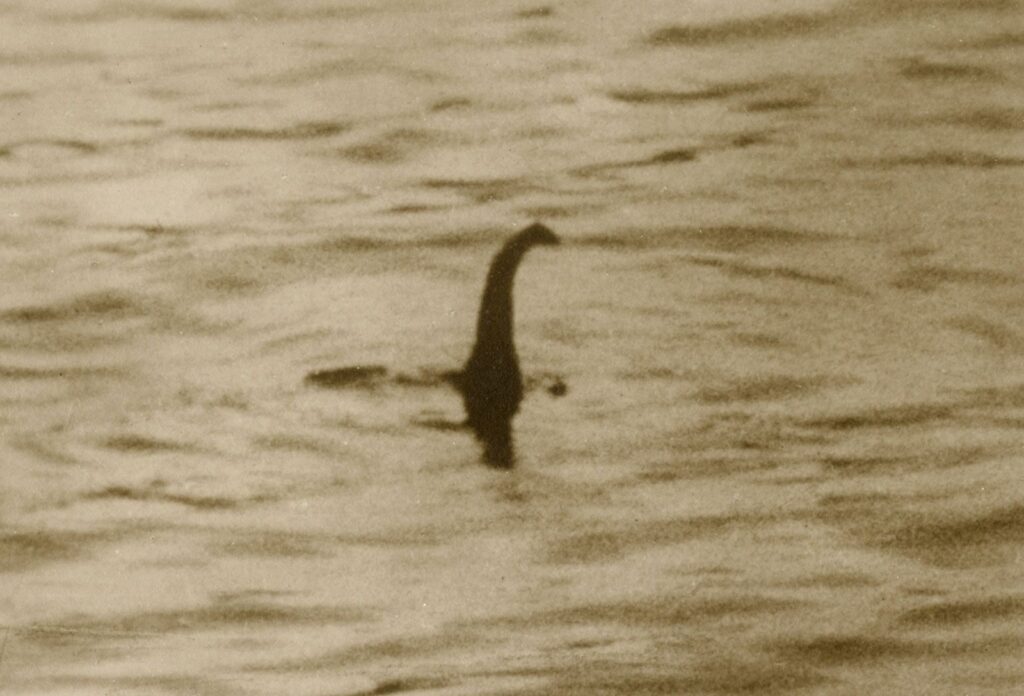
Then came the image that, for decades, served as the face of the legend. In April 1934, an Australian newspaper reported that the Daily Mail had published photographs said to have been taken by a “West End surgeon,” Dr. Robert Wilson, showing a small head and a snake like neck rising from the loch. PBS’s NOVA account emphasizes why the photo struck so hard: from the moment it was published in the Daily Mail, it became the very image of the monster, in part because it appeared to come from a credible source, a respected London physician.
The photograph is, by modern standards, minimal: a dark shape, a suggestion of curve, ripples that could be read as motion or as ordinary water. But minimal evidence is often the most potent kind for folklore, because it leaves room for the mind to move. A clear, high resolution image would have pinned the creature down to a scale and a taxonomy. The surgeon’s photograph did something more powerful. It provided a silhouette that the imagination could inhabit, and that silhouette could be reinterpreted endlessly without ever collapsing into a single ordinary explanation.
Notice also what the photograph taught the public to look for. Once an image becomes iconic, it trains perception. People did not just look at Loch Ness after 1934. They looked for a long neck and a small head. The story became a template, and the template shaped what counted as a sighting. This is one way folklore evolves in a media age: the legend stops being only a narrative. It becomes an image, and the image becomes a filter through which the world is scanned.
The surgeon’s photo did not remain uncontested. According to NOVA’s account, in 1994, sixty years after the photo’s publication, researchers publicized evidence and confession claims that the image was a fake, part of an elaborate plot to dupe the Daily Mail. NOVA describes a chain of discovery involving earlier newspaper claims, the rediscovery of an uncropped photograph that included background scenery, and a confession attributed to Christian Spurling, who, according to the same account, described a model built by attaching a head and neck to a toy submarine. The story also links the hoax to grievances in an earlier “footprints” episode associated with the Daily Mail.
NOVA adds an important detail that belongs in any honest retelling: even the hoax story has skeptics. It notes that some questioned whether toy submarines of the 1930s could have performed as described, and raised questions about timing and disclosure. Still, NOVA also reports that after the 1994 revelations, most people came to believe the surgeon’s photo was a hoax.
The hoax did not kill Nessie. In a way, it fertilized the legend. If the best photo is a fake, believers can say, then we were fooled once, but the creature might still exist beyond the reach of cameras. Skeptics can say, if the best evidence was manufactured, then belief is a cultural artifact. The culture usually chooses a third path. It keeps the monster, but it shifts the monster’s center of gravity from zoology to folklore, where hoaxes are not merely embarrassment but part of the legend’s anatomy.
A hoax succeeds not merely by forging an image but by forging a context. The surgeon’s photograph gained power because it was linked to professional respectability and promoted by a major newspaper as exclusive evidence. Its life depended on social trust: trust in a credentialed witness, trust in media gatekeeping, trust that the world still held surprises. When that trust becomes part of the story, the story becomes richer, not poorer. The legend now contains not only a creature, but also a lesson about credibility, desire, and the way institutions can amplify the extraordinary.
Why lake monsters keep returning
Lake monster cryptids fascinate us because they inhabit a perfect ecological niche in the imagination: bounded, local, and strategically hidden. A lake is a container for mystery. It has edges you can stand on, but it also has depths that can be measured and still never fully watched. Loch Ness is long and dark, a body of water in which ordinary animals can become unfamiliar silhouettes at a distance, and in which wakes can take on meanings the water never intended.
Psychology supplies another ingredient. Humans are pattern finding creatures. We take ambiguous stimuli and snap them into meaningful forms, a tendency known as pareidolia. When you stand by a loch primed by stories, a wave can become a hump, floating debris can become anatomy, and a brief disturbance can be upgraded to a creature in the mind’s taxonomy. The Washington Post’s account of Nessie hunting explicitly links interpretive variation to pareidolia and to “expectant attention,” the heightened readiness to perceive a monster when one arrives already believing that a monster might be there.
Folklore scholarship offers a broader frame that helps explain why fascination persists even when specific pieces of evidence collapse. An open access essay on cryptids argues that legendary monsters are woven into community narratives and can reflect communal anxieties, environmental fears, and the interplay between local legend and mass media portrayal. In this view, Nessie is not merely a candidate species. Nessie is a cultural instrument: a way to keep a place enchanted, a way to stage the boundary between the known and the unknown, and a way for a community to possess a mystery that cannot be exported by outsiders without visiting the site itself.
Scottish water folklore provides a premodern template for this kind of myth. Cultural summaries of Scottish mythology describe kelpies as supernatural water horses said to haunt lochs and rivers, often framed as cautionary tales about danger near water and deception in appearances. A lake monster legend can be read as a modernization of that older warning system. The supernatural horse becomes a prehistoric creature. The moral warning becomes an invitation to watch the water. The old terror becomes a touristable thrill, with the same dark undertone: deep water is never entirely domesticated.
Images accelerate this process. Oral stories evolve through retelling, but photographs evolve through copying. The surgeon’s photograph created a visual standard that could be repeated, parodied, and reenacted. In doing so, it transformed a local mystery into a global meme long before the internet. A single silhouette became a shared mental image, and once a culture has an image like that, it can survive the exposure of fraud because the image has become more than evidence. It has become a symbol.
Lake monsters also function as a safe form of longing. They let us imagine that the world still has hidden animals, that discovery is still possible, that nature still contains secrets immune to bureaucracy. The Washington Post’s account notes the gulf between the intensity of observation at Loch Ness and the lack of conclusive images, suggesting that the legend thrives not because the evidence is strong, but because the desire is part of human nature.