
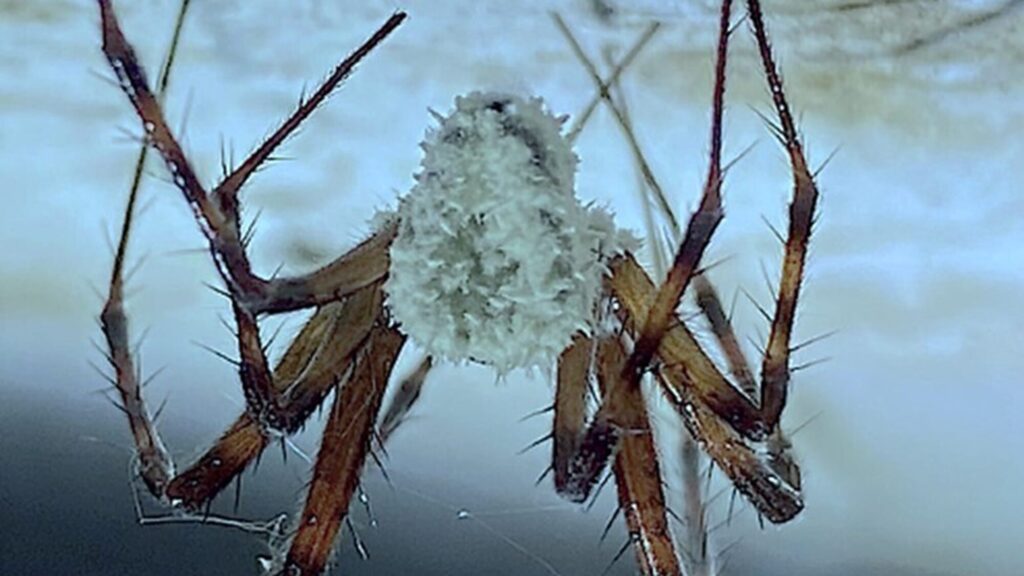
Deep within a damp, dark cave in Ireland, a lone spider clings to the wall. Its usual instinct is to hide in shadows and spin its web out of sight. But tonight, something is different. Drawn by an unseen force, the spider crawls away from its web and toward the mouth of the cave, into an open space exposed to the cool night air. If anyone were watching, they might find this behavior strange, almost as if the spider were acting against its own nature. In truth, the puppet strings guiding this spider are not its own. A parasite has taken hold, turning the arachnid into a mindless wanderer. By the time the spider dies, a ghostly white fuzz will sprout from its body like cottony antlers. A new fungal conqueror has announced itself to the world, a real-life “zombie” maker that preys on spiders.
The strange fate of those cave spiders might have gone unnoticed, were it not for a chance encounter. In 2021, a BBC nature documentary crew filming in a Northern Ireland cave spotted something unsettling: a spider hanging immobile from the cave ceiling, adorned with what looked like a delicate frost. To their surprise, the spider wasn’t lurking in a crevice but hanging openly from the ceiling, a behavior quite out of character for this shy species. On closer inspection, the “frost” was a fungus, sending tendrils out of the spider’s lifeless body. The crew had stumbled upon a phenomenon rarely seen in that part of the world. It turned out to be a parasitic fungus that hijacks its host. Researchers were alerted, and soon scientists from the UK and Denmark joined forces to investigate this grisly marvel. They ventured deeper into the cave to find more examples, and indeed several spiders hung in similar postures, dusted with white like miniature Halloween props. Samples were carefully collected and brought back to the lab. Under the microscope, the fungus revealed itself in intricate detail: a web of filaments consuming the spider’s tissues and tiny spore-bearing structures ready to release at the right moment. It was clear that this parasite was not a one-off fluke but a hidden player in the cave’s ecosystem. The scientists confirmed that they had discovered a new species of fungus, one that specifically infects spiders. In honor of the famed naturalist who has inspired generations to look closely at nature, the fungus was named Gibellula attenboroughii, after Sir David Attenborough.
Turning a spider into a zombie might sound like science fiction, but this fungus’s strategy is a result of millions of years of evolution. When a microscopic spore of G. attenboroughii lands on a spider’s exoskeleton, it begins to germinate. The fungus infiltrates the spider’s body, likely through thin joints or membranes, and then it starts to grow. Inside the spider, the fungus spreads like an invasive ivy, digesting the creature from within. The spider, for its part, likely has little awareness of what’s happening – its nerves and muscles might be chemically coerced by the invader. To any outside observer, the infected spider’s behavior becomes strangely purposeful but devoid of its normal survival instincts. In effect, the creature is alive but not acting of its own will, a puppet of the fungus. Remarkably, the pathogen avoids killing the host immediately. Instead, it takes control of the spider’s behavior. Cave orb-weaver spiders are usually reclusive, preferring the safety of their webs in dark corners. Yet, infected individuals abandon their webs and march as if compelled into the open, often climbing up cave walls or onto ceilings. This serves the fungus’s purpose. By driving the spider to an exposed spot, the parasite ensures that when the spider finally dies, the fungal spores can catch air currents or drip down onto new victims below.
This eerie method is strikingly similar to what another group of fungi, the Cordyceps, do to ants in tropical rainforests. In the Amazon, a “zombie ant” fungus famously compels an ant to climb a plant and cling to a leaf vein before it dies, allowing the fungus to sprout from the ant’s head and rain spores onto the colony below. The spider parasite in Ireland appears to be a close parallel, tailored to arachnids instead of insects. It even grows out of the spider’s corpse in bizarre forms. Scientists noted pale, spindly stalks emerging from the dead spiders, structures which then release new spores. Interestingly, the researchers found G. attenboroughii infecting two species of cave orb-weaver spiders and not others, suggesting it is a very specialized parasite. In nature, many of these “zombifying” fungi are highly specific, with each species of fungus often targeting just one type of host. This precision means the fungus has evolved tricks to bypass its victim’s defenses, but it also ties the fungus’s fate to that particular host species. Such adaptations are the product of an arms race between host and parasite, honed over ages. For us observers, however, it looks like something out of a nightmare: life forms that can direct the behavior of other creatures against their will.
Finding a new species is always exciting to scientists, but discovering one that turns animals into zombies carries a special intrigue. First, it expands our understanding of biodiversity in a unique environment. Caves are isolated worlds, with many species that exist nowhere else, and a hidden web of interactions. The discovery of G. attenboroughii reveals that even in the depths of a cold Irish cave, evolution has been busy crafting complex relationships. It tells scientists that there may be more undiscovered fungal puppeteers lurking in other dark corners of the world. Each new parasite found is a piece of a grander puzzle about how life adapts and survives.
This fungus also has practical implications. Spiders play a crucial role in ecosystems as predators of insects; a widespread fungal infection could upset that balance. These orb-weaver spiders in caves might be few in number, but they could be important in controlling the populations of cave-dwelling insects and providing food for other animals (like bats or birds that occasionally venture into cave mouths). If a pathogen like this were to spread unchecked, it might reduce spider populations and inadvertently lead to surges in pest insects. Understanding it helps ecologists gauge potential risks to cave ecosystems and beyond. On a more hopeful note, studying such fungi can inspire innovations. The Cordyceps fungi, for example, have already been investigated for use in biological pest control. Imagine harnessing a fungus to naturally curb crop pests instead of using chemical pesticides. Moreover, compounds derived from parasitic fungi have contributed to medicine (one famous drug, cyclosporine, originated from a fungus and revolutionized organ transplants by preventing rejection). The newfound spider-zombifying fungus might similarly harbor biochemical secrets, perhaps enzymes or molecules with antimicrobial properties or other uses. In short, exploring these oddities isn’t just a curiosity; it could be valuable for human technology and health.
Climate Change and Fungal Fears
One of the more unsettling aspects of this discovery is the reminder it provides of how environmental change can reveal new threats. Historically, “zombie” fungi like Cordyceps (Popularized by the “The Last of Us” media franchise) thrived in tropical regions. Finding a similar fungus in the cool climate of Ireland raises questions: has this genus been here all along, unnoticed, or is it a sign that such pathogens are expanding their range? As global temperatures warm and weather patterns shift, organisms big and small are on the move. Species that once stayed confined to the tropics may find new footholds in temperate zones. A warming climate could make northern forests and caves more hospitable to fungi and other parasites that previously couldn’t survive there.
Climate change might also stress wildlife, making animals more susceptible to infections. We have seen hints of this in other cases: amphibians around the world have been devastated by a chytrid fungus, and bats in North America suffer from white-nose syndrome (a fungal disease) when their hibernation is disrupted. While those crises aren’t directly caused by climate change, warmer conditions can exacerbate the spread of invasive fungi or weaken the hosts. In the case of G. attenboroughii, one could speculate that if winters become milder and caves wetter, the fungus might grow more easily and infect more hosts. More generally, fungi often lurk out of sight until something tips the balance in their favor—whether it’s a change in temperature, moisture, or the movement of hosts into new areas. A slight uptick in warmth or humidity can sometimes trigger a fungal bloom or enable a pathogen to jump to a new host species. These possibilities make scientists pay close attention to how climate trends and disease outbreaks might be intertwined.
There’s also a broader, almost philosophical concern. Fungi are ancient and incredibly adaptable. For the most part, humans and other warm-blooded animals have been safe from fungal takeovers. Our high body temperature is a barrier many fungi can’t overcome. But as the planet warms, fungi are gradually adapting to higher temperatures, inching closer to being able to infect mammals. Some scientists have pointed out that new fungal pathogens have been emerging, possibly due to this adaptation. One such example is a yeast called Candida auris, which in recent years has mysteriously emerged on different continents and can infect humans; researchers suspect that global warming helped it adapt to the temperature of the human body. It’s a sobering thought: in a hotter, more unstable climate, the boundary between the fungal world and the animal world could shift in unpredictable ways. While a fungus turning spiders into zombies in a cave might not directly threaten us, it symbolizes how much we still don’t know about the living world, and how climate change might stir up disturbing surprises.