The history of the jack-o’-lantern
On a wet November evening in a small Irish museum a grey, puckered turnip sits behind glass like an embarrassed relic: a human mouth carved in haste, candle wax hardened into furrows where eyes should be. You can almost feel the hurry in the cuts—the maker had weather to beat, tools that were blunt, a purpose that mattered more than artistry. It looks less like a quaint craft than like a utility item made by people who needed light, warding, or a signal fast. Hold that image; it refuses the tidy story that the orange pumpkin on a suburban stoop invites.
That modest object does three things at once. It is a household fix—hollowed root plus fire. It is a marker of seasonal labor—something you make when the harvest is done and the nights have lengthened. And it is a statement at a boundary: this is my doorway, this is my household, this is my place between one world and the next. The modern jack‑o’‑lantern carries all those functions forward, but it also smuggles in accidents of language, migration, agriculture, and commerce. The story of how a carved root and a marshlight became an orange icon is not a straight line; it’s a palimpsest, a set of layered usages that have rubbed up against one another until meaning blurred into durable ambiguity.
Start with a word. For centuries in England and Ireland the phrase jack‑o’‑lantern described a natural phenomenon: ignis fatuus or will‑o’‑the‑wisp—the small, misleading lights that bob over bogs and marshes. “Jack” was a convenient anthropomorphic tag, the sort of name people give to weather and mischief when they want to make the world a little more intelligible. The name carried mischief in itself: it belonged to lights that sometimes lured travelers into danger. So the phrase arrived already carrying a doubled message—beacon and trap.
That linguistic passenger later found a narrative body in Stingy Jack, a ragged, moralizing folk figure whose devil‑outwitting, heaven‑shunned afterlife explains why a man might be condemned to roam with only a coal in a hollowed vessel for a lamp. The tale appears in many local shapes; Jack’s avarice, his tricks, the hollowed vegetable are all motifs rather than fixed plot points. What matters is that the story provided a human face to the anonymous marshlight and a neat origin for a lit hollow: someone was cursed to walk with a light that was also shame. The tale did what good folk tales do—it gave public anxiety a private cause.
Parallel to these verbal migrations, people were doing practical things with the season’s crops. Ethnographers and museum collections record that in parts of Ireland, Scotland, England, and Wales, households hollowed turnips, mangel‑wurzel, beets, or similar roots and carved ugly, sometimes grotesque faces into them at All Hallows’ Eve. They propped them by doors or windows. They used them in mumming, masking, and guising. Those carved roots were small, utilitarian, and designed more to startle than to charm. If the turnip‑face looks austere now, that austerity is not aesthetic choice so much as context: people were carving winter food, not props for a photoshoot.
It’s tempting to stitch all of these pieces into a single, ancient continuity: a Celtic festival called Samhain, customs to honor or frighten the dead, a tradition surviving into modern Halloween. There is some truth in the broad claim—pre‑modern northern Europe did have seasonal rites clustered around harvest and the onset of winter, and medieval Irish texts do mention Samhain as a time marked by livestock, timekeeping, and other boundary‑making activities. But historians caution against an unbroken line back to an Iron Age ritual whose practices and meanings arrived intact on contemporary porches. Evidence shows variation by place and time; the neat “ancient pagan origin” tale is a Victorian favorite that simplifies a messier history. The sensible position is not to deny continuity outright but to acknowledge how much reinvention, reinterpretation, and invention there has been—especially as writers and antiquarians in the 18th and 19th centuries framed local customs in romantic narratives of national heritage.
The material environment nudged those customs in a decisive way. When Irish and Scottish immigrants carried guising and root‑carving traditions to North America in the nineteenth century, they met a landscape where pumpkins grew big and plentiful. The pumpkin was not chosen for symbolism so much as for convenience: larger flesh, thin rind, easy to hollow, and conspicuous on a late‑autumn field. Practicality becomes iconography. The American pumpkin did not replace the turnip because someone preferred orange; it replaced the turnip because it made the work cheaper and more theatrical. By the late nineteenth and early twentieth centuries, literature, newspaper accounts, and museum notes show pumpkins firmly established as the medium of choice for lanterns in American Halloween practice.
There’s a small, revealing irony here. The turnip’s carved face tended toward grim, protective grotesque; the pumpkin, being bigger and smoother, allowed for friendlier, more legible expressions—triangle eyes, toothy grins. That shift is not merely an aesthetic progression; it tracks social change. In rural villages, carved roots might serve as talismans against real fears—wolves, thieves, spirits wandering near winter food stores. In a 20th‑century suburb, the same silhouette becomes a festive prop that announces a party or a trick‑or‑treat invitation. The object didn’t change its essential materials—plant plus light—but social context converted protective hostility into theatrical cheer.
This small history exposes a recurring human logic: hollow plant forms have long been repurposed as containers for sacred fire, masks, and beacons. Across agrarian worlds, people turn what they harvest into things that carry light and meaning. In some traditions a gourd is a vessel for offerings; in others it is a stage for a masked face. The jack‑o’‑lantern is, then, a local permutation of a widespread tendency: plants that are plentiful at the end of the growing season are pressed into service as instruments for negotiating the boundary between abundance and want, the living and the dead, the safe and the dangerous.
Another recurring theme is contradiction. The marshlight that gave the phrase jack‑o’‑lantern its first meaning was dangerous because it misled. The carved lantern could be protective because it presented a masked face at the threshold, meant to confuse or frighten spirits. In stories and practice, the same sign can mean both come and go, guide and deceive. That doubleness might explain why the motif persists: it holds two human needs at once—the desire for orientation and the fear of being guided astray. Objects that can be both beacon and snare are, oddly, useful at liminal times.
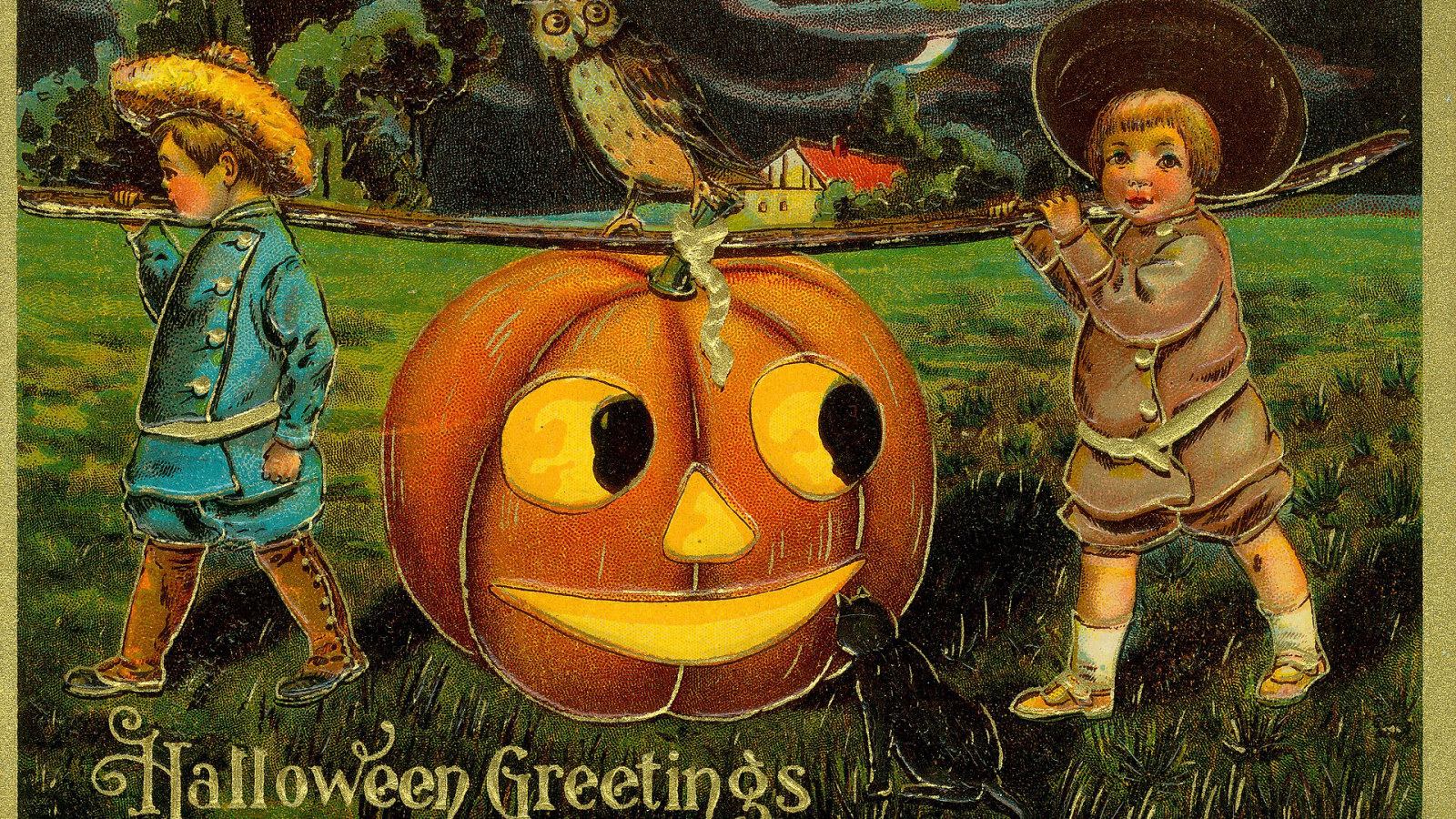
Over the 20th century other forces consolidated the pumpkin’s modern image. Commercialization, popular media, and suburban life turned guising into trick‑or‑treating and placed the jack‑o’‑lantern firmly inside a family‑friendly ritual economy. The face that once might have been meant to frighten became a commodity signifier for seasonal identity. Pumpkins filled catalogues and grocery aisles; carved faces populated greeting cards and children’s books. The holiday’s anxiety—about death, about the thinning of boundaries between worlds—was domesticated into costumes, candy, and municipal lighting. Ritual fear was repackaged as play.
That domestication has not been total. There are still pockets where the older textures show: regional festivals in Ireland and Scotland sometimes revive the turnip tradition as a corrective to Americanized Halloween, museums keep a few weathered roots with a kind of reproachful patience, and some contemporary carvers deliberately reach back toward grotesque, elaborate masks that feel more like protective talismans than cute decorations. The Stingy Jack tale lives on in classrooms and in storybooks because it is narratively satisfying, but when you look closely at versions of the tale across geography you see a family of stories rather than a canonical origin myth—a sign that oral tradition does not so much fix a past as keep it pliable.
There’s a subtle moral here about the materiality of ritual. We like to think of symbols as pure; often they are not. The pumpkin’s rise illustrates how ecology and economy can determine emblematic form. Rituals do not float apart from the physical world; they are made out of what’s at hand. When objects change—when fields produce different crops, when markets supply new tools—the rituals adapt. That adaptation can both preserve and transform meaning. The jack‑o’‑lantern preserved the idea of a lit hollow at a threshold even as it changed its face, its scale, and its emotive effect.
Language, too, surfaces as an agent of change. The phrase jack‑o’‑lantern migrated, shifted reference, and contracted toward a new, more domesticated signifier. A marshlight that once terrified and an itinerant damned man who once skulks about with a coal both contributed frames for a household object lit to mark the season. Words often travel faster than practices; in this case the phrase brought metaphoric resonance that helped stitch local customs into a new, more portable tradition.
Why does any of this matter beyond satisfying curiosity? Because the jack‑o’‑lantern is a small, accessible case study in how communities create continuity without being stuck to the past. It shows how fear becomes theatre and how theatre can preserve, in caricature, a real anxiety about mortality and change. It shows how migration, ecology, and commerce are not mere background conditions but active shapers of ritual. And, more plainly, it makes visible an everyday—the jack at the porch light—that we usually take for granted.
So what should you look for the next time you pass a porch with a glowing face? Notice whether the face seems to invite or to warn. Notice the labour it implies: carved in haste or carefully detailed? Notice the vegetable used. Those small things are traces of choices large and small—choices about practicality, about meaning, about how much fear a community is willing to carry into public view. The jack‑o’‑lantern’s work, historically, has been to hold those choices up to a flickering light.
In the end, the jack‑o’‑lantern is not one thing. It is a linguistic traveler, an agrarian improvisation, a household tool, a theatrical prop, and a commercial icon layered atop older practical and symbolic uses. Its persistence is not proof of a single, unbroken tradition but the sign of a practice that has always been willing to adapt—to different crops, different landscapes, different economies—while keeping a core architecture intact: hollow a plant, put in a light, mark a threshold. That architecture is at once simple and suggestive: it invites both protection and misdirection, community and solitude, humor and a shiver. The achievement of the jack‑o’‑lantern, then, is neither to preserve an ancient rite nor to become merely a commodity; its achievement is to be a durable answer to seasonal anxieties—an answer that, by design and accident, remains deliciously ambiguous.