
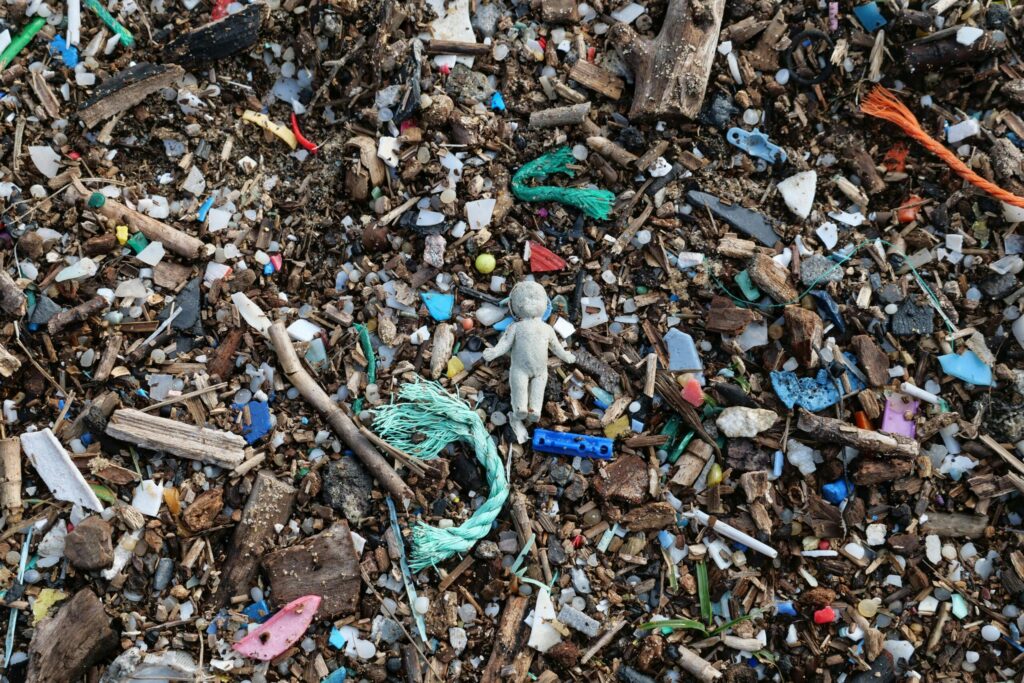
Every day, countless primary microplastics enter the environment directly through human use. When you rinse off a face scrub that contains tiny polyethylene beads, those particles swirl down the drain and pass through water treatment filters with ease, eventually emptying into rivers and oceans. Each time you wash a fleece jacket or polyester shirt, hundreds of thousands of synthetic microfibers spin off into the wastewater. These fibers slip into waterways as well, joining the flow toward larger bodies of water. Wind can pick up plastic dust from industrial sites or landfills, carrying it far afield. And whenever a car brakes or tires roll along the pavement, imperceptible bits of polymer wear off and disperse into the air and roadside soil. Plastic has quietly woven itself into the fabric of our lives, and through these small pathways it continuously leaks into nature.
In addition to these direct sources, secondary microplastics are generated by the breakdown of larger plastic litter. Consider a plastic soda bottle discarded on a beach. Day after day, the sun’s ultraviolet light makes the plastic brittle. Waves crash and toss it around, sand scours its surface. In time, the bottle splits into pieces; those pieces further split into smaller bits. A single bottle can create innumerable microplastic fragments. This process is happening wherever plastic waste exists – and plastic waste is truly global. From densely populated cities to uninhabited islands, plastic trash has found its way there and is gradually creating microplastics. Ocean currents corral some of this debris into massive garbage patches, where the plastic breaks into tiny pieces that float just below the water’s surface like a soup of confetti. Some microplastics sink into seafloor sediments; others wash up on beaches, mixing into sand. On land, plastics in open dumps or plowed into soil similarly fragment and spread. No corner of Earth is untouched. Microplastics ride the jet stream and fall with the snow in polar regions. Scientists have discovered them on the highest mountain peaks, such as Mount Everest’s snow, and in the deepest ocean trenches. In a real sense, we have introduced a new kind of dust into the planetary system – plastic dust that travels on wind and water, permeating the globe.
Impacts on Wildlife and Ecosystems
What does this invisible invasion mean for living creatures and the environment? In the world’s oceans, microplastics have become a pervasive pollutant, infiltrating food webs from the smallest to the largest organisms. Tiny plankton and fish larvae unintentionally dine on microplastic bits, mistaking them for food. A fleck of plastic drifting in seawater can look just like a planktonic egg or a tasty morsel of algae to an anchovy or young fish. Tragically, a belly full of plastic provides no nutrition. Some young fish, lured by these indigestible pieces, stop eating real food and slowly starve with stomachs full of plastic. Researchers have observed fish larvae in laboratory settings preferentially eating plastic particles over actual food, a fatal choice that stunts their growth and can kill them before they ever reproduce. Even when marine creatures don’t outright die, the plastic they consume can cause internal injuries or give them a false sense of fullness. Over time, a fish, turtle, or seabird that accumulates too many plastic bits may become weak and malnourished.
Beyond the physical hazard of clogging digestive tracts, microplastics can act like sponges for toxins. Plastic particles tend to absorb harmful chemicals from seawater, such as pesticide residues or industrial pollutants. When an anchovy or a mussel ingests microplastics, it may also be dosing itself with that concentrated cocktail of toxins. These chemicals can leach out inside the animal’s body, potentially interfering with its hormones, reproduction, or immune system. Moreover, plastics themselves are made with additives – dyes, softeners, flame retardants – some of which are known to be biologically active. For instance, chemicals like bisphenol A (BPA) or phthalates can mimic hormones (acting as endocrine disruptors) in both animals and humans. As microplastics degrade, they might release these additives into organisms that ingest them. Studies on seabirds and marine mammals have found not only the presence of microplastics in their guts, but also signs of related inflammation, liver stress, and altered hormone levels.
Ecosystems are beginning to show subtle shifts due to the presence of these particles. Beaches laden with microplastics may have different heat properties, possibly affecting turtle egg incubation. In soil, microplastics might change how water flows or how roots grow. There’s even emerging evidence that airborne microplastic particles can influence cloud formation, since water droplets can condense on them – hinting that, at a planetary scale, the plastic we’ve released could potentially have climatic effects. We are only just starting to understand these wide-reaching impacts. What’s clear is that microplastics have woven themselves into the cycles of nature. They travel through food chains: plankton eat plastic, fish eat plankton, bigger fish eat those fish, and so on – with plastic moving up each step. Top predators like whales, dolphins, and birds of prey have all been found with microplastics inside them. Imagine a majestic albatross soaring for thousands of miles over open ocean, only to return to its nest and regurgitate bits of plastic to its chick along with real food. This is the new reality on our planet.
Our Own Invisible Intake
It’s disquieting to realize that humans, too, are part of this contaminated web. If nearly every level of the food chain now carries microplastics, then we inevitably ingest them as well. We eat fish and shellfish that contain microplastics. We drink water – even tap water and bottled water have been found to contain microscopic plastic fibers shed from bottling and packaging. We breathe air that carries synthetic dust from clothing and carpets. Some studies have estimated that the average person might be consuming on the order of grams of microplastics per week from various sources – one oft-cited comparison equates this to roughly the weight of a credit card ingested weekly. Whether that figure is perfectly accurate or not, it highlights the startling notion that we are regularly taking in tiny bits of our own trash.
What happens to these particles once they’re inside us? The smallest microplastics (and nanoplastics) are so small that they can potentially penetrate tissues or enter the bloodstream. In recent scientific studies, microplastic particles have been detected in human blood samples for the first time. They have also been found in the lungs (even in the tissues of patients undergoing surgery, suggesting we inhale them from the air), and in the placenta of unborn babies. This means that no organ is necessarily off-limits – plastic specks could circulate and lodge in various parts of our bodies. Understandably, this raises concerns. Could these foreign particles trigger inflammation or immune reactions? Early research suggests yes: cells exposed to microplastics in lab settings show stress responses. There is worry that, over time, these particles might contribute to illnesses such as cancers, or disrupt endocrine (hormonal) function due to the chemicals they carry. Some extremely tiny particles might even cross into the brain or other sensitive organs, though much is still unknown.
At this point, medical science is racing to keep up with the exposure that has already occurred. We do not yet have definitive evidence of microplastics causing specific human diseases – such effects, if they exist, might take decades to manifest or to study. But the precautionary tale is evident when we consider historical pollutants like asbestos or lead: by the time the harm was undeniable, exposure had been widespread. With microplastics, we are essentially conducting a global experiment on ourselves and every other creature. We have unleashed these minuscule artifacts of modern life into every corner of the environment, and now they are circling back to us in what we eat, drink, and breathe.
How do we reconcile the benefits of a material that has made life convenient and safer in many ways, with the knowledge that its waste is haunting us at a microscopic level? It is a curious predicament of the human story. Plastic was an invention meant to save animals (early plastics replaced ivory and tortoiseshell) and to create durable goods. In a poetic twist of fate, those very durable goods have become a new, persistent form of pollution – one that slips through the cracks of our world’s filtering mechanisms. We stand at a point in history where the legacy of a single century of plastic use will echo for millennia in the form of these tiny particles.
Yet, awareness is the first step toward change. Around the world, researchers and innovators are seeking solutions: better waste management, biodegradable plastics that truly break down, filters to catch microfibers from washing machines, and microbes that might dine on plastic. There is even a kind of beauty in the collaboration between science and nature as we search for ways to heal what we’ve wrought. In the style of a futurist gaze, one can imagine technologies that might one day cleanse the oceans of their microscopic debris or genetically adapted enzymes that help break plastics apart safely. But for now, every individual and every community can play a part by reducing plastic use and disposal, to stem the flow at its source.
Microplastics remind us of an essential truth about our planet: everything is connected, often in unseen ways. The throwaway choices we make – a bag carelessly discarded or a product washed down the drain – can come back to us in unexpected fashion. In a sense, these tiny plastic particles are like ghosts of our material culture, haunting the water, the air, the soil, and our own flesh. They challenge us to rethink how we live and what legacy we want to leave. Will future generations dig into earth strata and find a line of plastic dust marking our era? Possibly. But perhaps they will also record that this was the time we recognized the interdependence of human health and environmental health – and took action to turn the tide. The microplastics problem, though daunting, also brings a message of hope: it is a human-made issue, which means we have the power to solve it. Like a mirror, these particles reflect our own ingenuity back at us, urging us to apply that same ingenuity to forge a more sustainable relationship with our world.